
Are the copper strands able to be safely removed while using your equipment to strip 28AWG wire? 7 years ago, I began my career in the wire and cable sector with wire striping and crimping machine. This seems like a little error, but I’ve seen it cost manufacturers a pretty penny.
What follows is an explanation of the functions of a wire strip and crimp machine as they pertain to very thin wires. Blade settings, crimp force, and wire damage prevention are all topics covered. To further assist you in making an informed decision, I will also demonstrate which sectors make use of these devices.
What Is a Wire Striping and Crimping Machine?
The dual purpose of a wire striping and crimping machine is dual. It starts by taking the plastic cap from the end of the wire. After that, it attaches a metal termination to the exposed copper. Additionally, certain machines can precisely trim the wire to length. Automatic wire cutting, stripping, and crimping machines are what they are called. They cut, strip, and crimp in one continuous cycle.
Time is saved and tools are not needed because of this. Automobiles, electrical gadgets, healthcare equipment, and many more things rely on these machinery. The wire striping and crimping machine needs to be adjusted meticulously for tiny wires, such as 28 AWG. Copper might be nicked or terminals crushed if the setting is incorrect.
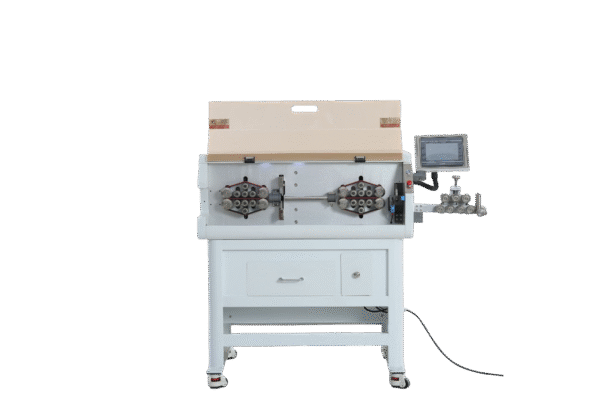
Wire Gauge vs. Machine Type: A Quick Guide
| Wire Gauge | Conductor Size | Strip Length | Machine Type Needed |
| 28 AWG | 0.32 mm | 2 – 6 mm | Precision automatic |
| 26 AWG | 0.40 mm | 3 – 8 mm | Standard automatic |
| 24 AWG | 0.51 mm | 3 – 10 mm | Mid-range automatic |
| 22 AWG | 0.64 mm | 4 – 12 mm | General purpose |
| 18 AWG | 1.02 mm | 5 – 15 mm | Heavy duty automatic |
How Do Blades Affect 28AWG Wire- Safe or Risky?
Among the several settings for thin wire, the blade gap is crucial. Too narrow of a space causes the blade to sever the copper. The cover won’t come off easily if it’s too large. The margin is less than 0.05 mm for 28 AWG wire, which is quite narrow.
A precise blade adjustment is a feature of high-quality automated wire striping and crimping machines. Simple dials are used by inexpensive equipment. Even with a tiny wire, that won’t cut it. A machine that allows for digital or micro-adjustment controls is required. By doing so, the blade gap is maintained consistently.
Blade Types for Fine Wire Stripping
| Blade Type | How It Cuts | Best Wire Type | Damage Risk |
| V-Blade | Radial cut | Standard round wire | Low |
| Flat Blade | Straight cut | Flat or ribbon wire | Medium |
| Rotary Blade | Spinning cut | PTFE or silicone wire | Very low |
| Laser-Edge | Ultra-fine cut | Micro or coax wire | Extremely low |
Tips to avoid blade damage on 28AWG:
- Position the blade gap at a height 1 mm above the copper diameter.
- Cut PTFE or silicone insulation with rotary blades.
- Crush the wire by replacing worn blades.
- Before beginning full production, always test a single strip.
Manual vs. Digital Blade Adjustment
| Feature | Manual | Digital |
| Accuracy | ±0.10 mm | ±0.01 mm |
| Setup Time | 10–20 min | 2–5 min |
| Best For | 22 AWG and above | 28 AWG and below |
| Consistency | Varies by operator | Same every cycle |
You must need digital blade control for 28AWG wire. The small space needed by a thin wire is impossible to maintain using manual techniques.
What Crimp Force Is Safe for 28AWG Terminals?
When the crimp force is too high, the copper strands become crushed. If there is insufficient, the terminal will come loose. A crimp force of 80 to 200 N is considered safe for 28 AWG wire. This force may be adjusted in the software of a high-quality wire striping and crimping machine unit. Uncertainty is eliminated. Shape of the die is also important. Using the incorrect die might result in crimp gaps or oversqueezing the wire.
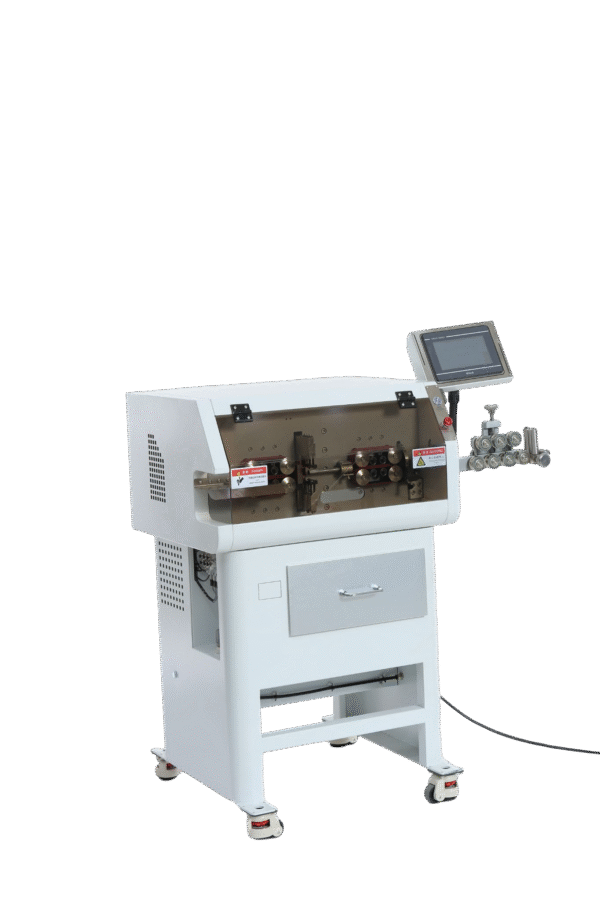
This leads to the wire eventually breaking. Every crimp undergoes a pull test at companies that manufacture automotive or medical components. With its integrated force checks, a wire cutting, stripping, and crimping equipment provides data in real-time. This prevents the machine from leaving with defective crimps.
Crimp Die Guide by Terminal Type
| Terminal Type | Wire Gauge | Die Profile | Crimp Height | Min Pull Force |
| Open-Barrel Pin | 28 AWG | B-Type | 0.75–0.90 mm | 15 N |
| Closed-Barrel Pin | 28 AWG | F-Type | 0.80–0.95 mm | 18 N |
| Ferrule Terminal | 28 AWG | Hexagonal | 0.70–0.85 mm | 20 N |
| JST Connector | 28 AWG | Custom JST | 0.72–0.88 mm | 17 N |
Pros of Crimp Force Monitoring:
- Quickly identifies problematic crimps
- Lowers the threshold for doing pull-tests
- Warns you when the die is losing its edge
- Assists with certifications and quality records
Cons of Crimp Force Monitoring:
- Increases the wire striping and crimping machine’s price
- Regular calibration checks are necessary.
- Changing terminals could necessitate software upgrades.
Which Industries Need Fine Wire Automatic Machines Most?
Very thin wires are being used by many sectors. Wires with a gauge of 30-32AWG are common for phones. Even thinner ones are used by medical sensors. The 26-28AWG wire harness is used by automobile computers. Connections that are both clean and dependable are required for that. Inconsistent and sluggish hand tools aren’t up to the task. The output of an automated wire stripping and crimping equipment is consistent.
A fully automated wire cutting, stripping, and crimping equipment can cost anywhere from three thousand to fifty thousand dollars. The optimal cost is proportional to the wire diameter, terminal type, and daily production volume.
Frequently Asked Questions
How safe is it for a standard machine to process 28AWG wire?
The majority of conventional machinery is not made to handle 28 AWG. One with a delicate blade control and a gentle crimp force setting will do the trick. Bad crimps and nicks in the strands will result in their absence.
- Determine the blade gap using computerized means.
- Before you buy, be sure the wire striping and crimping machine can handle the size of your terminal.
- Begin by running a test batch.
Question 2: When removing copper strands, what causes them to be damaged?
Tightening the blade gap won’t let it go. Thus, the blade comes into contact with the copper. The wire becomes weaker with each nick. Another reason for this issue is dull blades.
- Blades should be inspected every fifty thousand cycles.
- For skinny wire, use sharp, hardened blades.
- Next, use a magnifying glass to examine the ends of the wires once everything is set up.
For 28AWG wire, what is the recommended crimp force (Q4)?
From eighty to two hundred Newtons, depending on the endpoint. A wire can’t withstand excessive pressure. If there isn’t enough, the terminal will not open.
- Put a stop to it in code, not simply hardware
- Before each die change, measure the crimp height.
- At the beginning of every shift, double-check.
How can I determine if a crimp of 28AWG is adequate?
Activate a pull test. Minimum force required for a decent 28AWG crimp is 15-20 N. At the end of each shift, use a micrometer to record the crimp height.
- Each batch of fifty units must undergo a pull test.
- At the beginning of every shift, measure the crimp height.
- For the best results, use crimp force monitoring.
Conclusion
The delicate 28AWG wire is prone to nicks and cuts. Your product might be destroyed if you use the incorrect wire striping and crimping machine, blade, or crimp force. Fortunately, this is all remedied by using the correct machine. Pick a fine-wire-specific machine. Be careful when you set your blades. Choke with the correct die and the correct force. Then each time, your crimps will be neat and firm.
Opt for VIMFUN for optimal results. From the start, their automated wire stripping and crimping equipment was designed for use with thin wire. Servo crimp force, digital blade control, and excellent after-sale service are all features it offers.