
Cable harness production is one of the most essential processes in modern industries such as automotive, electronics, aerospace, and household appliances. The quality and efficiency of cable harnesses directly impact product performance and safety. Traditionally, manual wire strippers were used in cable preparation. However, as production volumes increased and precision requirements became stricter, the automatic wire stripping machine emerged as the preferred solution. This article explores how automation improves cable harness production and compares it to traditional manual stripping methods.
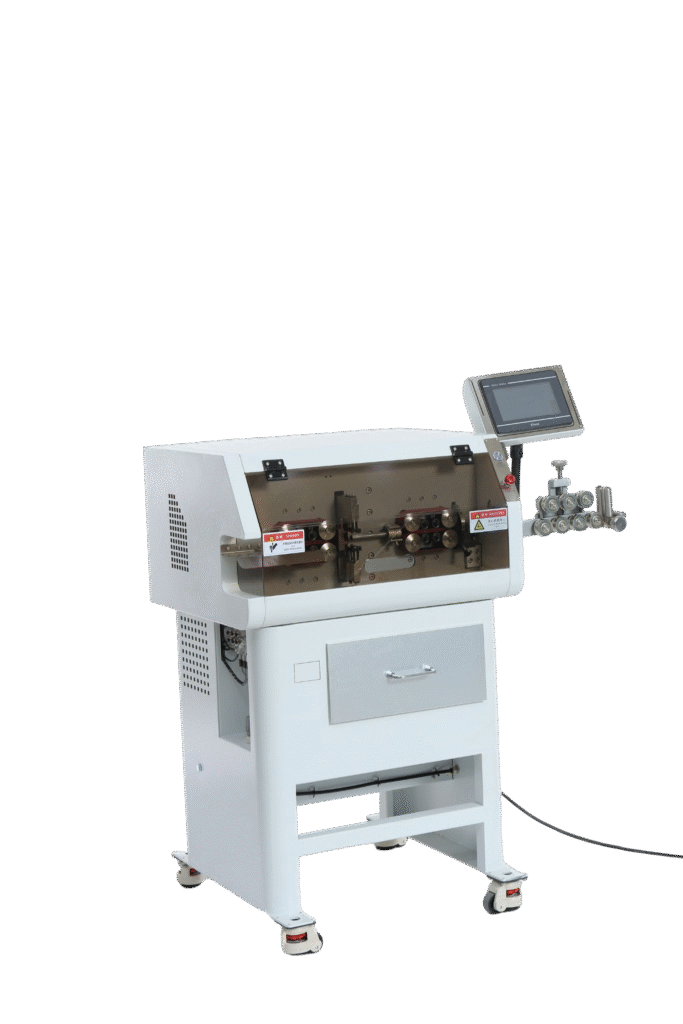
Precision and Reliability in Wire Processing
Manual wire stripping tools often depend on the operator’s skill level. Even experienced workers can produce inconsistent results, which may lead to damaged conductors, uneven lengths, or incomplete insulation removal. An automatic wire stripping machine, by contrast, ensures precision and repeatability.
- Machines can be programmed for specific wire gauges, insulation thickness, and strip lengths.
- Sensors and automation prevent over-stripping or conductor damage.
- Consistent output reduces rework and guarantees harness reliability.
This level of accuracy is particularly critical in automotive and aerospace applications, where even small defects in wiring can cause severe performance or safety issues.
Labor Efficiency and Production Speed
Manual stripping requires significant manpower, especially in factories producing thousands of harnesses daily. Workers must adjust tools, measure lengths, and strip wires individually. This process is both slow and prone to fatigue-related errors.
With an automatic wire stripping machine, one operator can oversee the processing of hundreds or thousands of wires per hour. This automation reduces the dependency on skilled labor, cuts down on production time, and enables factories to scale their operations efficiently.
VS Comparison: Manual Wire Stripper vs Automatic Wire Stripping Machine
| Feature | Manual Wire Stripper | Automatic Wire Stripping Machine |
|---|---|---|
| Precision | Dependent on operator skill | Consistent, programmable accuracy |
| Speed | Suitable only for small-scale work | High-speed processing, thousands per hour |
| Labor Requirement | Labor-intensive, requires skilled workers | Minimal supervision, reduced labor cost |
| Consistency | Results vary from worker to worker | Uniform results across all wires |
| Cost Efficiency | Low initial cost, high long-term labor expense | Higher initial investment, cost savings over time |
The comparison highlights that while manual tools may be sufficient for small workshops or repair jobs, automatic machines dominate in industrial-scale production.
Industrial Applications of Automatic Wire Stripping Machines
- Automotive Industry – Producing complex wiring harnesses for vehicles requires precision and reliability. Automation ensures every wire is stripped accurately, reducing risks in safety-critical systems.
- Electronics Manufacturing – High-density devices such as smartphones, computers, and medical instruments demand consistent and fine-tuned wire processing.
- Aerospace – Aircraft and spacecraft require extremely reliable wiring systems. Automatic stripping machines guarantee the repeatability needed for such critical applications.
- Household Appliances – Large-scale production of washing machines, refrigerators, and air conditioners benefits from automated wire stripping’s speed and consistency.
Cost Effectiveness Over the Long Term
Although an automatic wire stripping machine has a higher upfront cost compared to manual tools, it delivers significant savings in the long run. Lower labor requirements, fewer errors, and reduced material waste contribute to higher profitability. For manufacturers seeking to increase capacity while maintaining quality, automation is a strategic investment.

Conclusion
The automatic wire stripping machine is transforming cable harness production by delivering unmatched precision, consistency, and efficiency. Compared to manual tools, it reduces labor dependency, accelerates production, and ensures higher-quality results.